
Arrest History in Grundy County
The Grundy County Sheriff makes arrests in unincorporated areas, executes county warrants, and operates the jail. Morris, Minooka, Coal City, and Channahon police keep records of their own arrests. Illinois State Police handles highway and state investigations, while Conservation Police handles DNR offenses. The creator of the report remains its custodian even when the person is later housed in the Grundy jail.
An arrest history can connect several booking cycles over time, but no verified official county portal publishes that complete view. Agency reports, jail entries, Circuit Court cases, and ISP fingerprint cycles cover different events and time spans. Search each relevant layer and use identifiers rather than assuming that one same-name record establishes identity.
Fingerprint intake sends identifiers and a transaction-control number toward the Illinois State Police Bureau of Identification. Later qualifying court dispositions are reported separately. Delays or unmatched identifiers can leave a state cycle without a final result, so compare the local case and use ISP's challenge process when reviewing one's own record.
Which Grundy Agency Owns the Report?
| Event | First Records Channel | Next Check |
|---|---|---|
| Unincorporated county arrest | Grundy Sheriff Records/FOIA | Jail, then Circuit Clerk |
| Morris incident | Morris Police FOIA | Jail and Grundy/Judici |
| Minooka or Channahon incident | Village police records | Confirm county of filing |
| Coal City incident | Coal City police/village FOIA | Confirm Grundy or Will venue |
| State-highway arrest | Illinois State Police records | Jail and clerk if filed locally |
A city police narrative cannot be certified by the sheriff, and the Circuit Clerk normally holds filed judicial papers rather than the complete investigative report.
Geography is especially important in villages that cross county lines. Minooka extends into Grundy, Kendall, and Will Counties, and Channahon also spans counties. The agency name alone does not prove which clerk received the prosecution. Ask for the county, court, case number, or warrant number before searching.
How to Look Up Grundy County Arrests
Start with a full name, approximate date, location, and arresting agency. A report or booking number is the strongest locator. Grundy has no verified public inmate roster, warrant name-search page, or official app-only booking tool, so a careful lookup uses direct contacts and written requests.
- Call the Grundy jail at 815-941-3243 for current lodging information, or the sheriff's 24/7 nonemergency line at 815-942-0336.
- Ask the arresting agency's records unit for the incident or arrest report; sheriff Records is at 815-941-3240.
- Search Grundy cases through Judici after the State's Attorney has had time to file charges.
- For one's own statewide record, use ISP Access and Review with fingerprints; use authenticated CHIRP for public Illinois conviction information.
- Submit a focused Illinois FOIA request to the correct agency for releasable report or booking fields that routine channels do not provide.
Finding a Booking Without a Public Roster
The sheriff's published navigation exposes no official public inmate list. That absence is not proof that no booking occurred. A person may have been released, transferred, cited without lodging, held elsewhere, or entered under details that differ from the searcher's information. Call the jail for present custody and request the booking record for a historical event.
The Grundy County Jail at 111 East Washington Street in Morris has a rated capacity of 65 and holds people awaiting trial, serving sentences of one year or less, or serving periodic imprisonment. Rated capacity is not a current population figure. Mail, visitation, medical, protective-custody, and precise housing details are separate from the public booking fields.
Booking typically moves from agency paperwork and transport through identity questions, property inventory, fingerprints, photograph, charge confirmation, health and safety screening, classification, and the first court appearance. Some sensitive intake information is necessary for jail operations but is not an ordinary public-record field.
What an Arrest Record Shows
The arresting-agency record describes the event, allegations, officer action, and report identifiers. A jail booking record adds intake, identity, charge, custody, and release data. Exact public availability depends on Illinois FOIA, active-investigation concerns, privacy rules, and whether the record concerns a juvenile.
| Booking Number | A jail identifier useful for matching custody records and requests. |
|---|---|
| Booking Date & Time | When intake occurred, which may differ from arrest time. |
| Arresting Agency | Identifies the office that owns the underlying report. |
| Charges | Initial booking allegations and citations, subject to prosecutorial change. |
| Detention Status | Release conditions, court-ordered detention, or another current custody status. |
| Mugshot Policy | Booking photographs may be requested, but release is subject to Illinois law and exemptions; no public gallery was verified. |
| Release Status | Release, transfer, continued detention, or movement recorded by the jail. |
Requesting Segregable Arrest Records
The Sheriff's Records Division is open Monday through Friday, 8:00 a.m. to 4:00 p.m. Reports commonly reach Records three to five working days after an occurrence. A focused request should identify the report or booking type, date range, event location, involved person where needed, incident number if known, and preferred electronic format.
Send sheriff FOIA requests to foia@sheriff1.com or Grundy County Sheriff's Office, Attn: FOIA Officer, 111 East Illinois Avenue, Morris, IL 60450. Illinois FOIA normally provides five business days for a noncommercial response, with one statutory extension of up to five business days after notice. The first fifty black-and-white letter or legal pages are free; later pages may cost up to fifteen cents each. Request segregable public portions if investigative or private material is withheld.
A response may grant the request, release a redacted record, deny material with a cited exemption and review rights, report that no record was found, or identify a different custodian. A requester can seek review from the Illinois Attorney General's Public Access Counselor. Juvenile information, victim identifiers, medical material, confidential sources, investigative techniques, and security-sensitive jail details may be restricted without making every police report categorically secret.
Recent Arrests and Booking Logs
Because Grundy does not publish a verified official booking log or jail roster, direct custody confirmation is the working recent-arrest channel. Ask for the public booking identifier and arresting agency, then follow the event to the proper report custodian and, after filing, to the Circuit Clerk. A court case can appear later than the booking because prosecutors decide whether and what to charge.
No roster should be treated as a permanent arrest-history archive. Even where a neighboring agency offers a current list, entries can disappear after release. In Grundy, a citation or summons may create a court case without a jail booking, while a booking can end without filed charges.
VINELink can provide Illinois custody notifications, but enrollment does not prove a complete arrest or court history. Use it for notice of custody changes, then verify the underlying booking with the jail and the prosecution result through the clerk.
For a report that has not yet reached the sheriff's Records Division, allow for the stated three-to-five-working-day processing period. Current custody questions should still go directly to the jail. An ordinary crash report has a posted minimum charge of five dollars; reconstructed crash reports and recordings follow separate posted fees.
Grundy Jail Versus IDOC Search
The county jail is the correct channel for local pretrial and short-term custody. Once a sentenced person is committed to state prison, switch to the Illinois Department of Corrections Individuals in Custody search. IDOC results do not recreate the county arrest report or complete circuit docket, and county jail and state populations do not overlap perfectly.
The official IDOC search screen shows the separate statewide custody channel.
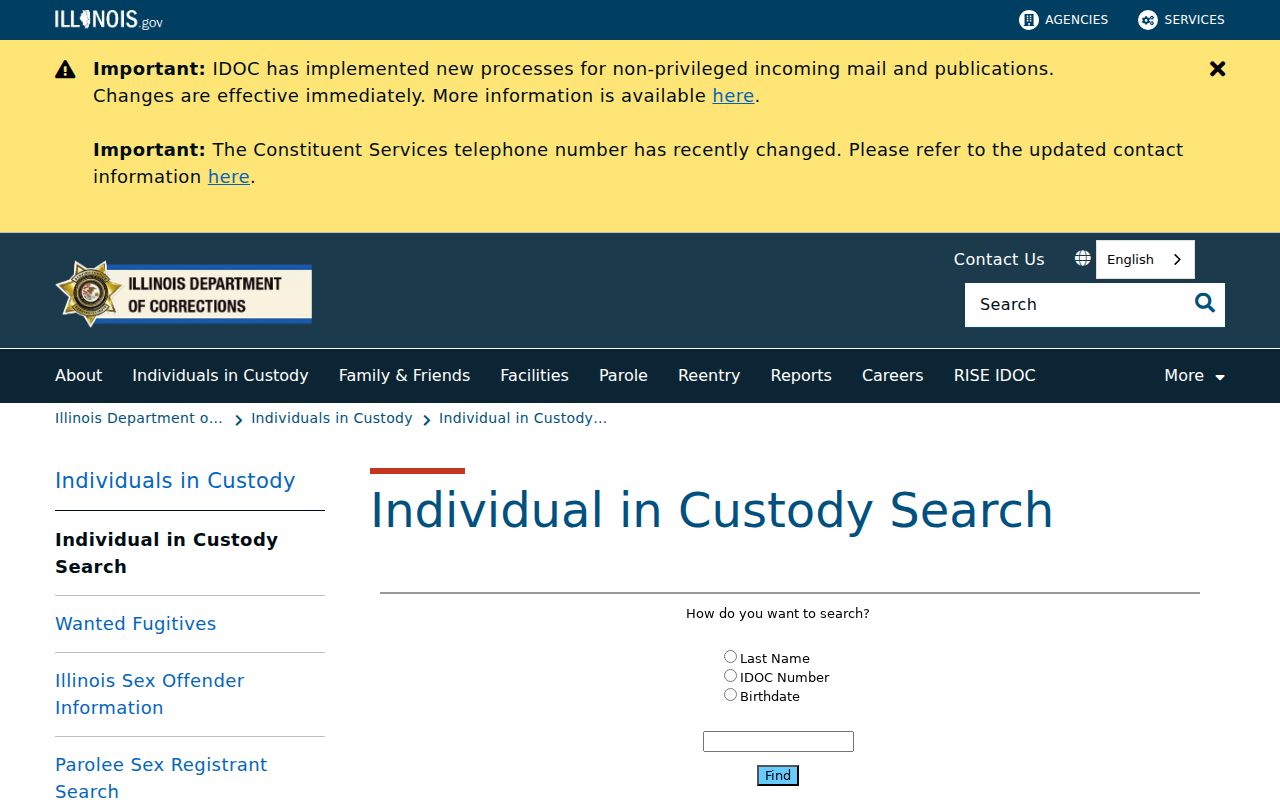
Use the IDOC identifier and custody details to confirm the right person, then return to Judici or the Circuit Clerk for the conviction and sentence documents.
No Cash Bail Does Not Mean No Detention
Illinois' current pretrial system uses conditions of release and detention petitions rather than the former money-bail structure for new cases. Prosecutors may petition for detention under 725 ILCS 5/110-6.1, and the judge decides under the statute. Old instructions referring to cash, surety, or ten-percent bonds should not be applied as the present default.
Read the booking status together with the court's latest order. A jail label can lag a hearing, and release may depend on an entered court direction. For a live decision, verify with the court or jail rather than drawing conclusions from an older docket line.
A warrant lookup follows a similar caution. Grundy has no verified public active-warrant name search. Call the sheriff's nonemergency line, use Records, check Judici for court entries, and contact the issuing court or counsel about resolution. An online “warrant issued” entry may later have been served, recalled, or quashed.
Arrests vs Convictions
An arrest entry records police action or custody; a conviction reflects a judicial finding of guilt. ISP's authenticated CHIRP product reports public conviction information held by the state repository, not the unrestricted law-enforcement rap sheet. One's fingerprint-based ISP Access and Review response is the correct identity-verified route for reviewing and challenging one's own full Illinois history.
| Arrest Record | Conviction Record |
|---|---|
| Created by police and, if booked, the jail | Created by the Circuit Court and reported to ISP |
| Shows an arrest or intake occurred | Shows a guilty judgment on a count |
| Lives with agency/jail and in repository cycles | Lives with the Circuit Clerk and state repository |
| May end in release, no charges, or dismissal | May lead to sentence, appeal, sealing, or later relief |
Note: An arrest is not proof of guilt. Charges may never be filed, and filed cases may end in dismissal or acquittal.
An eligible dismissal or released-without-charging event may qualify for expungement, while other outcomes may be sealable under 20 ILCS 2630/5.2. Clearing is not automatic. Obtain the statewide record and certified dispositions, file in the county of the arrest or charge, and ensure that the order names the arresting agency and ISP for distribution.