
Criminal Cases in Grundy County Courts
Felonies, state-law misdemeanors, DUI matters, traffic charges, and some ordinance cases are filed in the Circuit Court of the Thirteenth Judicial Circuit. Illinois does not send Grundy felonies to one clerk and misdemeanors to another. Common case-type codes include CF for felony, CM for misdemeanor, DT for DUI, and TR for traffic. The letters help identify the docket but do not state the outcome.
The Grundy County Circuit Clerk is the official file custodian. The County Clerk handles functions such as elections and vital records, not criminal dockets. A city administrative hearing may address an ordinance matter without creating a state criminal prosecution, so identify the tribunal before assuming that every municipal citation belongs in the criminal index.
Grundy County's Judici Search Fields
The Circuit Clerk and the Thirteenth Judicial Circuit direct public users to Judici for Grundy case information. The basic index is free, though registration or payment may apply to premium or document functions. County selection matters because a Minooka or Channahon event could be filed outside Grundy.
The official Judici county-selection screen shows why the first step is choosing the correct court.
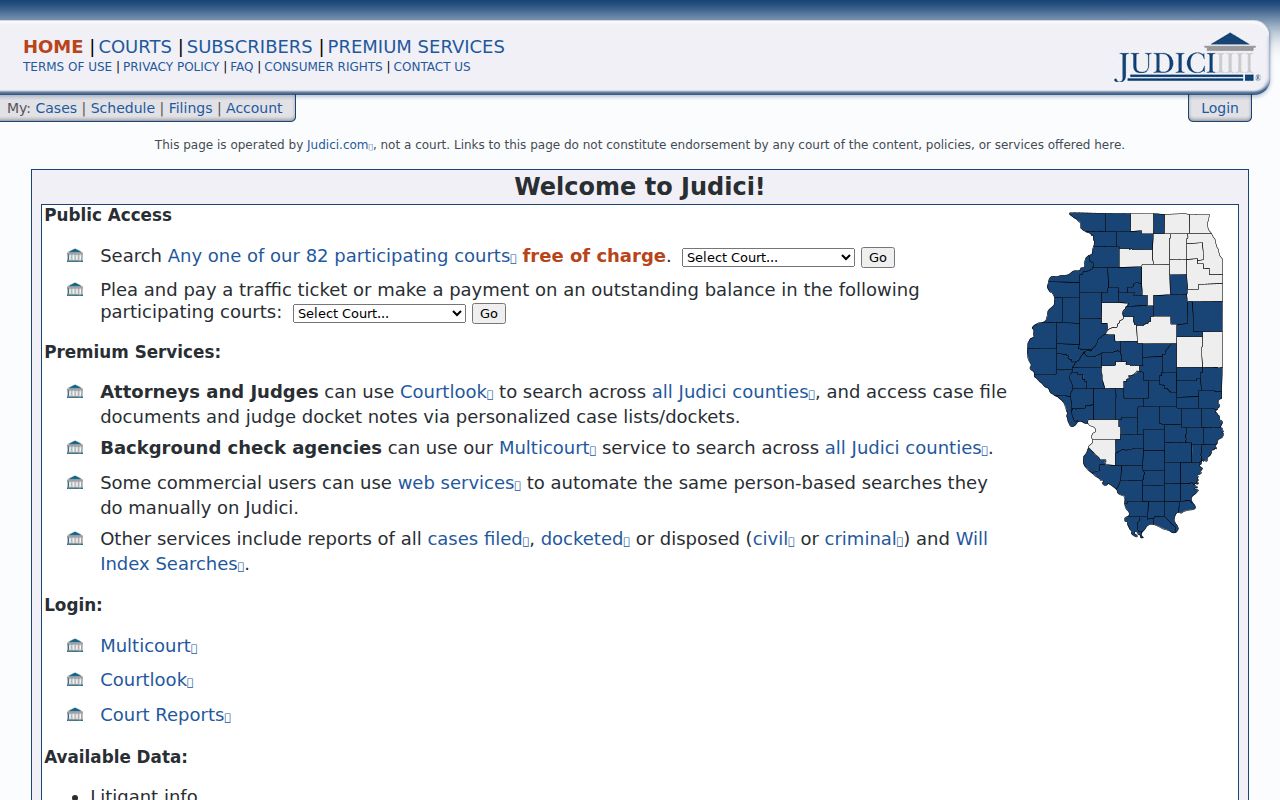
After selecting Grundy, use the name path for discovery or the formatted case-number path for a more exact match.
How to Search Case Records
Judici is the main remote search channel, but its index should be treated as a route to the court file, not a complete substitute for it. A case number is safer than a name. When only a name is available, compare the caption, case type, filing year, and other non-sensitive facts before deciding that a result belongs to the intended person.
- Follow the Circuit Clerk's online-records link to Judici and select Grundy County.
- Choose Search by Name or Search by Case Number; use the full formatted number when known.
- For a name search, add the first name and any available middle-name or birth-year refinement.
- Open the matching case, read every count and docket event, and locate the final judgment entry.
- Order an unavailable document or certified disposition from the Circuit Clerk rather than relying on a summary.
| Field Label | Type | Required | Notes |
|---|---|---|---|
| Court/County | Select | Yes | Choose Grundy County before searching. |
| Last name/business | Text | Name path | Start broad; spelling controls the matches. |
| First and middle name | Text | No | Useful for reducing common-name results. |
| Case number | Text | Case path | The formatted Illinois case number is most reliable. |
| Birth year | Number | No | Appears only where the county configuration enables it. |
The Grundy Judici search interface illustrates the county-specific entry point.
The visible controls may change, so use the live labels and reset the search if a narrow query misses a known case.
Room 30 Copies Beyond the Docket
A docket description is not necessarily a downloadable filing. When the needed judgment, sentencing order, charging document, or certified disposition is absent online, contact the Circuit Clerk at 111 East Washington Street, Room 30, Morris, Illinois 60450. The office is open Monday through Friday, 8:00 a.m. to 4:30 p.m., and the published main number is 815-941-3256.
The clerk accepts copy requests in person, by mail, and through its online copy-request channel. Standard copies are $2 for the first page, 50 cents for pages two through twenty, and 25 cents for each additional page; certification is $6 per document and exemplification is $12 per document. Payment directions and availability should be confirmed before ordering.
Describe the requested document precisely: case number, party name, filing year, document title, and whether certification is necessary. Certification matters when an official disposition is required; it is different from a plain informational copy. If the case number is unknown, perform the index search first so staff can locate the correct file without relying on a common name.
The official Circuit Clerk page introduces the services available at the records office.
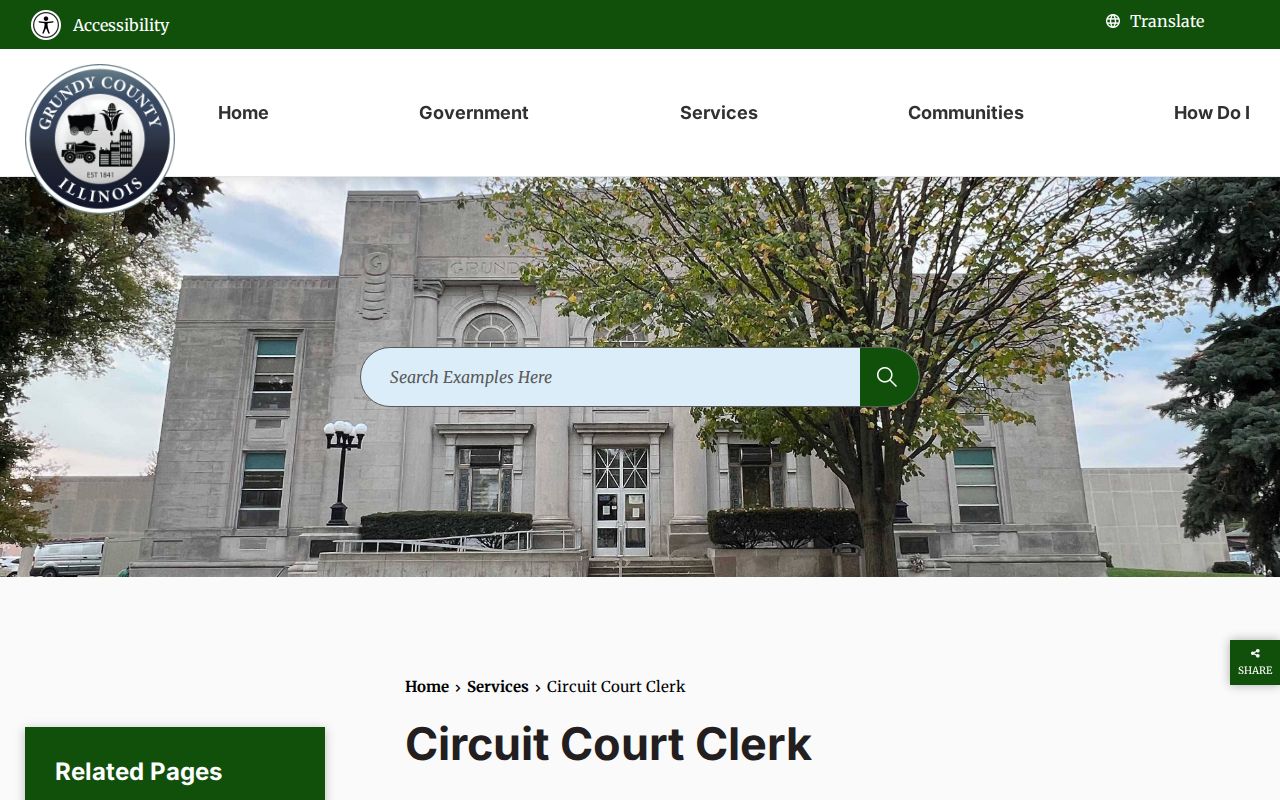
Use the clerk's current instructions when a docket line alone cannot prove the disposition or sentence.
What the Case File Shows
The court file records the prosecution rather than the original police investigation. Read the charging instrument to learn what prosecutors filed, the docket to follow procedural events, and the judgment or later order to determine the operative result. Initial charges can be amended, dismissed, or resolved differently count by count.
Financial entries may show assessments, fines, or payments, but they should be read with the sentence and later orders. A scheduled hearing date is not proof that the hearing occurred as planned. Continuances and amended calendars appear through later docket activity, so the newest entry is essential.
| Case Number & Court | Identifies the filing year, case type, sequence, and Grundy circuit venue. |
|---|---|
| Charging Document | Lists filed counts and statutes; it may differ from the arresting officer's initial allegations. |
| Docket Entries | Chronological notices, appearances, motions, warrants, orders, and minute entries. |
| Hearing Dates | Past and scheduled events; confirm current dates with the clerk. |
| Disposition & Judgment | Shows dismissal, acquittal, supervision, guilty judgment, or another count-specific result. |
| Sentence & Conditions | Records incarceration, probation, fines, and conditions ordered by the judge. |
Dismissed, Supervision, Convicted, Vacated
Dismissed or nolle prosequi means prosecution ended on that count without a conviction. Acquitted means a not-guilty adjudication. Supervision is an Illinois outcome in which judgment may be withheld while conditions are completed. Convicted reflects a guilty judgment after plea or trial. Vacated means a prior judgment or order was set aside; the later entry controls.
None of those labels should be read without the count and later docket activity. A dismissal does not automatically erase the arrest or booking cycle. Eligible records require the Illinois expungement or sealing process, and a case missing from Judici may instead be archived, impounded, non-indexed, or outside Grundy.
A warrant entry also needs a current-status check. “Warrant issued” can later be followed by service, recall, or quash, while sealed process may not appear publicly. Use the case number with the clerk or responsible law-enforcement agency before treating an old docket description as active.
Stages of a Criminal Case
An arresting agency creates its report and may lodge the person at the Grundy jail. The State's Attorney decides what charges to file, and the clerk opens the judicial case. Initial appearance and pretrial decisions follow; motions, discovery, plea discussions, or trial lead to a count-specific disposition. If guilt is established, the judge enters sentence. Appeals produce a separate reviewing-court record.
Case flow: Arrest › Booking › Charging decision › First appearance › Pretrial proceedings › Plea or trial › Disposition › Sentencing
A Practical Grundy Courthouse Visit
The courthouse record counter is in Room 30. Free downtown street parking is subject to a two-hour limit, and the official facility information lists a public-access copier, printer, internet access, law library, e-filing kiosk, and self-help center. Mobile devices are not allowed. A visitor who needs disability accommodation should contact the court's local disability coordinator in advance.
The official Grundy courthouse location page provides the current hours and visitor details.
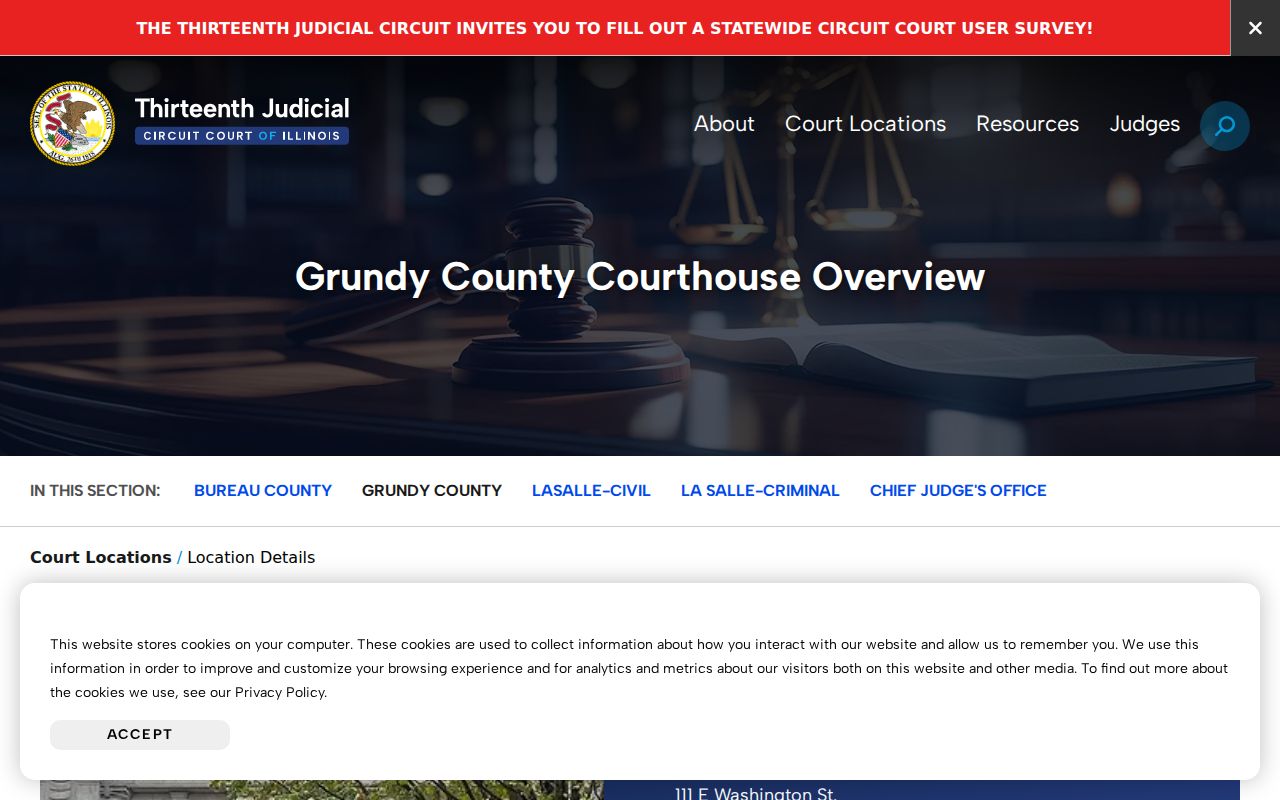
Confirm current access rules before carrying devices or planning an extended records review at the counter.
Finding Archived Grundy Court Cases
Modern online coverage is not the endpoint for an older search. Grundy County was established in 1841, and historical local-government records can move outside the working courthouse collection. The Illinois State Archives identifies the Illinois Regional Archives Depository at Illinois State University in Normal as a research channel for older Grundy holdings. Its searchable local-government records database can help determine whether a series and date range has been transferred.
Begin with the Circuit Clerk because the office can distinguish an active local file from archived material. If referred to IRAD, provide the court, approximate year, party name, case type, and any known case number. Archive access serves genealogy and historical research; it does not guarantee that every old case survives or that restricted records become public with age.
Federal cases are also outside this chain. Grundy County lies in the Northern District of Illinois, whose criminal dockets are searched through PACER rather than Judici or Room 30. A federal custody search belongs with the Bureau of Prisons. Neither federal system supplies a county police report, and county FOIA cannot compel a federal court filing.
Access & Restrictions
Illinois court files are generally open, but access does not override laws protecting juvenile matters, sealed or expunged cases, victim and minor identifiers, financial-account data, and other restricted information. Online views may omit data or documents that can still be inspected at the clerk's office, while some material remains unavailable in every public channel.
Illinois FOIA governs agency records but is not the process for ordering judicial documents from the Circuit Clerk. Ask the clerk whether a missing case is archived, impounded, or available only at the counter. Historic Grundy circuit materials may have migrated to the Illinois Regional Archives Depository at Illinois State University, making IRAD a separate path for genealogy and older-file research.
For one's own record-clearing work, collect certified dispositions for every arrest and case before using the Illinois Supreme Court forms. Expungement generally removes qualifying police and court records, while sealing restricts ordinary public access but preserves access authorized by statute. Eligibility depends on the entire Illinois history, offense, outcome, and waiting period, not a single docket label.