
How to Check Criminal History in Minooka
A Minooka records check must separate the village custodian from the county custodian. Village police keep their own incident and arrest reports across the municipality. County agencies take over only for the booking, prosecution, and court file in their jurisdiction. Illinois State Police receives qualifying criminal-history reporting later. Begin with the record identifier and geography, not a guess that every Minooka event belongs to Grundy County.
- Ask Minooka Police for the incident, arrest, crash, or citation number and confirm the event location.
- Use the official village FOIA channel for the releasable Minooka report, CAD entry, body-camera file, or other village record.
- Identify whether the filing or lodging county is Grundy, Kendall, or Will.
- Search that county’s circuit clerk and contact that county’s jail; use Grundy Judici only for a Grundy filing.
- For one’s own statewide identity-linked history, use Illinois State Police Access and Review with fingerprints.
This sequence connects the records without blending them. A Minooka police narrative, county booking, court judgment, and ISP history answer different questions.
Minooka Three-County Record Problem
Minooka’s whole incorporated area reaches into Grundy, Kendall, and Will Counties. That is not just a census detail. It changes which circuit clerk has a criminal case and which jail has a booking. A news item, conversation, or report may call an event a “Minooka arrest” because Minooka Police handled it, while the charge was filed in another county based on the incident location.
Use the police report number as the bridge. It can help Minooka staff locate the village file and can reveal location and linked case data. Next, read the citation, charging paper, or docket for the county name. Contact that county clerk and jail. Searching Grundy alone is reasonable only after a Grundy connection is confirmed. A zero-result Grundy Judici search should trigger a county check, a spelling check, and a filing-time check rather than a broad conclusion.
The Minooka Police Department
The official Minooka Police Department page is the right source for village-created law-enforcement records. A useful request names the exact record, incident number if known, event date, time and location, requester contact, desired delivery format, and commercial-purpose status where the village asks for it. Ask for reasonably segregable portions if an active investigation or privacy rule affects part of the file.
The official police source identifies the local department whose file remains with Minooka even when a later prosecution leaves Grundy County.
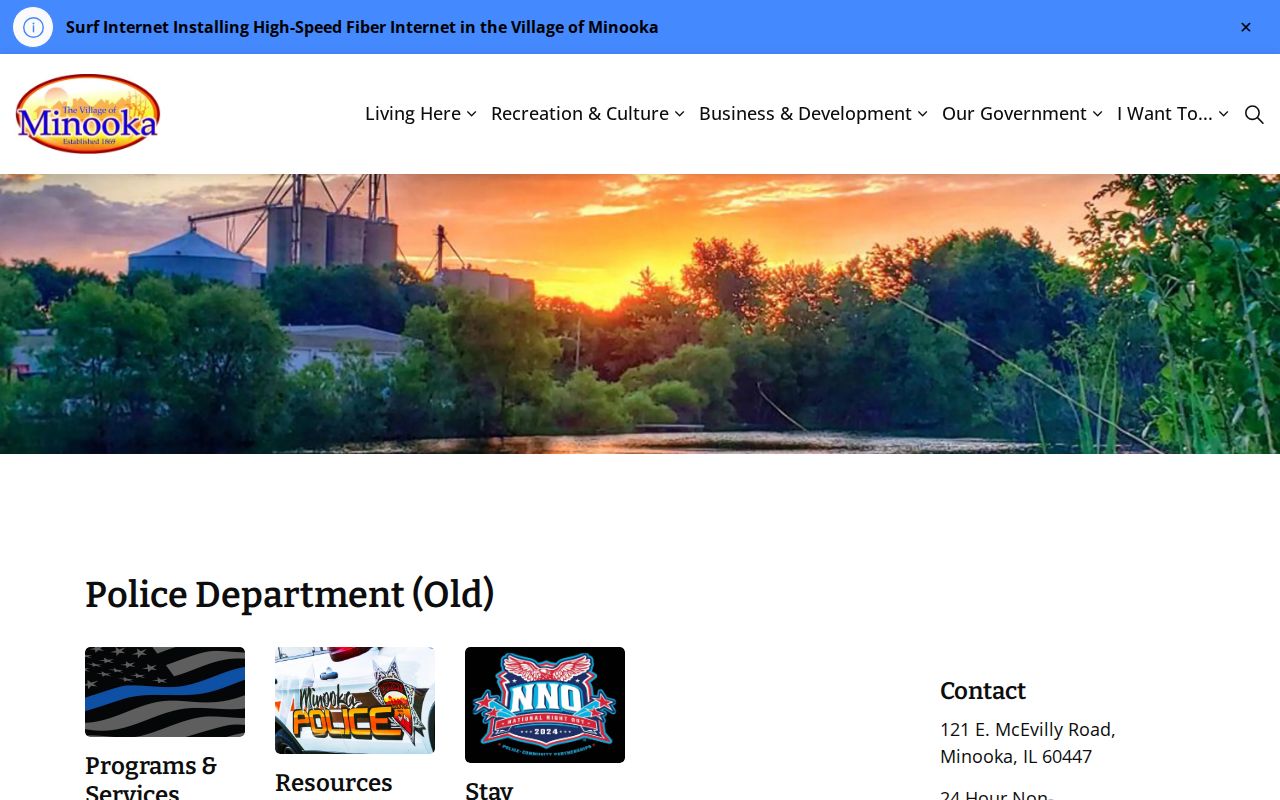
The village channel should be the first stop for a Minooka officer’s narrative, not a request to whichever county happens to be searched first.
No verified official Minooka Police mobile app with an app-only inmate or warrant lookup was found in the official sources. Avoid unofficial scanner, people-search, and jail applications.
Start with Minooka Report Numbers
A report number sharply reduces ambiguity. Minooka Police can use it to locate the agency file, and the file may identify the exact event location, arrest basis, citation, transport destination, or related court number. If the number is unknown, give a narrow date and time range, location, report type, and involved name only to the extent needed to find the record.
Different items require specific wording. Request “incident report” for the written agency account. Name 911 audio and CAD logs separately because retention and exemptions can differ. A body-camera request should include date, time, place, incident, and officer if known; the village may need time for review and redaction. For a crash, confirm whether Minooka Police or another agency investigated it. A county clerk cannot substitute for the police source because a filed court document rarely contains the whole investigative file.
Arrests and Bookings in Minooka
A Minooka arrest record concerns the officer’s enforcement act. A booking concerns intake at a particular jail. The two may exist in different jurisdictions and at different times. The arrest file can include the event date and place, alleged offenses, probable-cause basis, officer, transport, evidence, and report identifiers. The jail may add intake time, booking number, descriptors, fingerprints, initial charge list, custody status, and release movement.
A person arrested by Minooka Police need not be held in the Grundy County Jail. Confirm where the person was lodged. If Grundy is confirmed, call the jail at 815-941-3243 because the county has no verified public inmate roster. If another county is named, use that county’s official jail source. Later state-prison custody belongs in the IDOC Individuals in Custody search. None of these custody entries proves conviction, and a summons case may proceed without any jail booking.
Minooka FOIA or Court Copy
Village FOIA and a county court-copy request serve different custodians. Send Minooka a request for its police report, dispatch entry, body-camera recording, city policy, or administrative file. Ask the correct circuit clerk for a complaint, information, docket, hearing order, judgment, or certified disposition. The village cannot certify a county judge’s order, while a circuit clerk does not hold every Minooka investigative record.
| Need | Correct Minooka route |
|---|---|
| Officer narrative or arrest report | Minooka Police and village FOIA |
| Current jail custody | Jail in the confirmed lodging county |
| Filed charge and case outcome | Circuit clerk in the confirmed filing county |
| Own statewide Illinois history | ISP fingerprint-based Access and Review |
Illinois FOIA normally gives a public body five business days to respond to a noncommercial request, with one statutory extension of up to five business days and notice. A response may grant, redact, deny with legal grounds and review rights, report no responsive record, or identify another custodian.
Minooka Municipal Court Records
Minooka has no separate constitutional criminal trial court. Illinois state charges go to the Circuit Court in the county where they are filed. Village ordinance citations may use circuit court or the village’s current administrative-adjudication process, so confirm the forum on the citation or with the village. An administrative violation is not automatically a misdemeanor.
| Court Name | The appropriate Illinois Circuit Court; Grundy matters are in the 13th Judicial Circuit |
|---|---|
| Case Types Heard | State felony, misdemeanor, DUI, traffic, and qualifying ordinance matters |
| Case Lookup Channel | The circuit clerk for Grundy, Kendall, or Will; Judici when the selected county participates |
| What the Docket Shows | Filed charges, court events, orders, case status, disposition, sentence, and public financial entries |
| Copies & Fees | Set by the clerk holding the file; request the exact order and ask whether certification is needed |
For a confirmed Grundy filing, search by full case number through Judici. CF denotes felony, CM misdemeanor, DT DUI, and TR traffic in common Illinois usage, but the current portal legend controls.
When Grundy Shows Nothing
First verify that enough time has passed for prosecutors to file. A booking or police report can predate the public docket. Next, search spelling variants and use the case number if available. Compare public facts before assuming a same-name entry belongs to the intended person.
Then return to geography. Ask Minooka Police which county received the charge or which jail accepted the person. Check Kendall and Will through their official clerks when the event or filing occurred there. If the matter was a village ordinance, confirm whether it went through an administrative forum rather than a criminal docket. A missing public result can also reflect sealing, impoundment, archive status, or non-indexed material. It does not prove that a Minooka record never existed or was expunged.
Where Minooka Records End Up
The village record stays with Minooka Police. The booking and court branches then follow the correct county. Qualifying agency and court information later reaches the Illinois State Police Bureau of Identification. Because Minooka crosses county lines, the ordinary single-county flow must show three possible branches.
Record flow: Minooka Police › Grundy, Kendall, or Will County jail and Circuit Court › Illinois State Police Bureau of Identification
The state history is organized around identity and arrest cycles. It may include fingerprints, names and aliases, physical descriptors, arrest date, arresting agency, charges, court tracking, disposition, and sentence. Public CHIRP returns conviction information maintained by ISP. For one’s own full Illinois record and a correction route, use Access and Review. When a disposition is missing, get the certified order from the clerk in the county that filed the Minooka case, then use ISP’s Record Challenge process.
Minooka Village Record Gateway
The official Village of Minooka site is the gateway for current police, clerk, FOIA, and ordinance instructions.

The village source helps confirm current local contacts, but county court and jail details still depend on the event’s jurisdiction.
Minooka’s official 2025 Police Annual Report reported six force incidents, ten pursuits, four complaints, two injuries, and eight compliments. Internal review found five force events justified and one outside policy; nine pursuits were justified and one led to added training. Those are department operational figures, not a Minooka offense rate. Any crime comparison should identify Minooka Police, a named reporting year, and the ISP or FBI dataset used.
Public Access Rules for Minooka Records
Illinois FOIA covers village agency records but does not displace sealing, juvenile confidentiality, or court-access rules. Minooka may redact private data and specified law-enforcement information when disclosure would harm an active case, a fair trial, a confidential source, investigative methods, safety, or an investigation. Protected victim, minor, medical, Social Security, license, and security-sensitive data may be removed. Request the nonexempt, segregable parts.
Key Statutes:
Illinois Freedom of Information Act, 5 ILCS 140/3 - controls agency requests and the ordinary response timetable.
5 ILCS 140/6 and /7 - sets copying rules and important privacy and police-record exemptions.
20 ILCS 2630/5 - requires qualifying law-enforcement and court reporting to ISP.
20 ILCS 2635/2–3 - governs public conviction information and state accuracy procedures.
The first 50 black-and-white letter or legal pages are free under FOIA, with later pages capped at 15 cents each. Court-copy fees come from the clerk that holds the case. A FOIA denial should cite its basis and explain review rights.